SEO is evolving, and AI is taking over search. SEO & AI – A Practical Beginner’s Guide shows absolute beginners how to create content that ranks for humans and AI alike – step by step, with practical examples and actionable prompts. NOW 2nd Edition with an extra chapter, a larger glossary of terms, and more prompts!
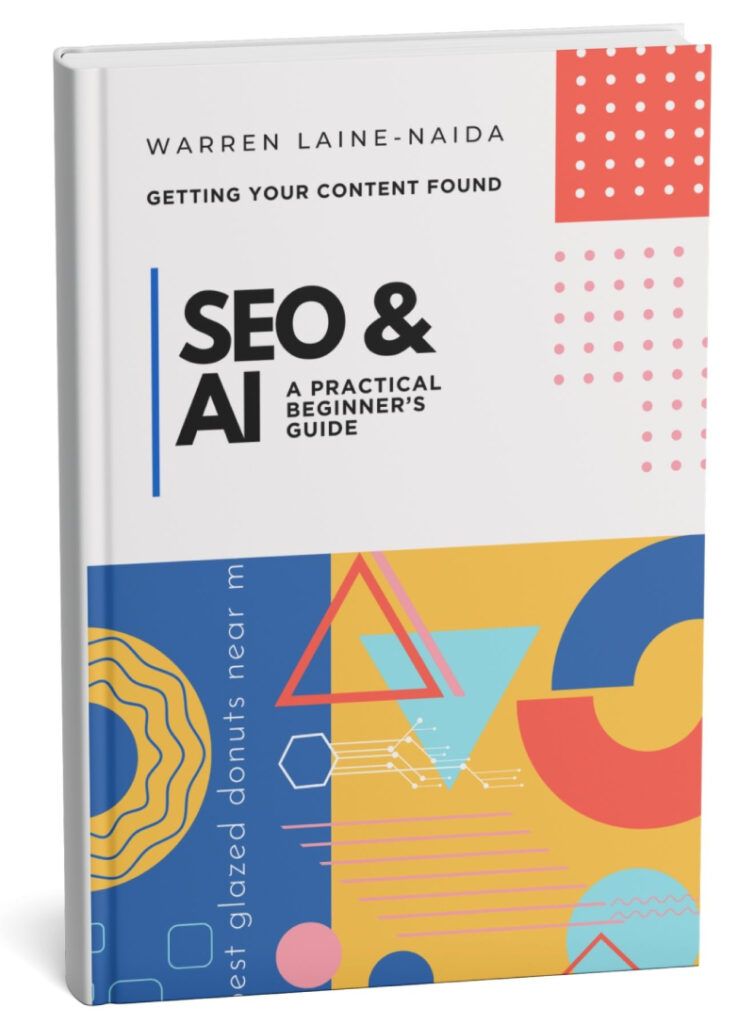
SEO & AI is available in English and in German
as a paperback, PDF, or eBook. 200 pages 2nd edition.
SEO and AI move fast. So why a book? Simple. It’s built for the classroom – and for saving time. No tab-hopping, no rabbit holes. Just open it. Perfect for beginners.
SEO is changing – but the basics still matter.
SEO focuses on entities, structure, and genuinely helpful content. LLMs (just like people and traditional search machines) reward clarity, not spam.
SEO & AI – A Practical Beginner’s Guide is the ultimate step-by-step handbook for absolute beginners who want to succeed in the new world of search.
Practical. Clear. Beginner-friendly. Future-focused.
Learn how to:
- Understand AI-driven search and layered visibility
- Find topics and keywords with AI
- Structure and write content that ranks for humans and AI
- Automate repetitive SEO tasks without losing control
With practical examples, AI prompts, and actionable workflows, this book makes SEO easy for beginners. Perfect as a standalone guide or as a companion to your learning course.
This book moves beyond the theory. It includes material from my articles and my SEO courses, and more than 80 Quick Check Questions to test your knowledge chapter by chapter.
Take control of your digital visibility – start mastering AI-powered SEO today!
What you will find in the book
PART 1: Understanding the Basics
Ch. 1 – What is SEO? Ch. 2 – What is Artificial Intelligence (AI)? Ch. 3 – SEO Before and After AI
PART 2: The New Search Landscape
Ch. 4 – How People Search Today Ch. 5 – Beyond SEO – AEO, GEO & AI Search Ch. 6 – Layered Visibility (Core Concept)
PART 3: Content That Works (For Google & AI)
Ch. 7 – Understanding Search Intent Ch. 8 – Finding Topics and Keywords (with AI) Ch. 9 – Writing SEO Content with AI Ch. 10 – Making Content AI-Readable
PART 4: Practical SEO Workflows
Ch. 11 – Your First SEO Article (Step-by-Step) Ch. 12 – Using AI the Right Way Ch. 13 – On-Page SEO Basics
PART 5: Automation & Strategy
Ch. 14 – What is “Automatic SEO”? Ch. 15 – Building a Content Strategy Ch. 16 – Scaling Content with AI
PART 6: Risks, Ethics & the Future
Ch. 17 – Can You Use AI Content for SEO? Ch. 18 – SEO Mistakes Beginners Must Avoid Ch. 19 – The Future of SEO
BONUS SECTION
Ch. 20 – Practical AI Prompts for SEO Ch. 21 – Tools & Resources
PART 7: Going Deeper on GEO
Ch. 22 – Entities: Who Are You on the Open Web? Ch. 23 – How RAG Actually Works (And Why It Changes Everything) Ch. 24 – AI Overviews: Anatomy of a New Search Result Ch. 25 – Platform Differences: Perplexity, ChatGPT, Claude, Gemini Ch. 26 – Testing Your GEO: A Monthly Practice Ch. 27 – Your GEO Action Plan: Start Here, Go From Here Ch. 28 2nd Edition Extra – Is Your Website Agent-Ready?
Contact Me with Questions or to Order a Copy
SEO and AI: Let’s Talk About What’s Actually Happening.
Search is changing. That’s not new. Search has always been changing. But this time it feels different – and I think it is.
AI is now part of how search works – not coming. It is here. Google is using it. Perplexity is built on it. ChatGPT is answering questions that your website used to answer. So the question isn’t whether AI SEO matters. The question is: what do you do about it?
Traditional search vs. AI search
In traditional search you are fighting for position – a ranked link that users choose to click.
In AI search you are fighting for inclusion – being cited, synthesised, or referenced in a generated answer that may never produce a click at all.
The goal shifts from ranking well to being citable, semantically clear, and contextually trusted. AI systems pull from multiple sources, extract relevant passages, and build their own answer. Your content either makes it into that answer or it doesn’t. That’s the new game.
So what is AI SEO, really?
It’s using AI tools to help your website get found, understood, and trusted – not just by Google, but by the AI systems people are turning to for answers. Things like Perplexity, Google’s AI Overviews, and yes, even Claude.
The old game was keywords. Stuff enough of the right words in, rank higher. That’s mostly done now. Today, it’s about whether a search engine – or an AI – actually understands what your page is saying and whether it trusts you enough to recommend you.
SEO vs GEO: LLMs don’t index info like a library – they learn like we do. We know things but often forget the source. If it is memorable we will say “My prof said this, I read it in the Times”, etc. This is why it is difficult to be cited by AI.
Google and Bing on the other hand index info to websites; they want the best overall website that ranks for a specific question. In effect, they prefer your prof, or the Times to you. :o) This is the key difference between SEO and GEO. Knowledge, not just data.
What changes with AI in the mix?
Quite a lot, actually. BUT, Bad SEO = invisible to AI. If Google can’t find you, AI won’t either.
AI reads context. It picks up on tone, intent, and meaning – not just matching words to words. So writing naturally, for real humans, with real answers to real questions? That matters more now, not less.
Some tools help you see trends before they peak, automate the boring stuff like audits, and figure out why your traffic dropped last Tuesday. You don’t have to do all of this manually anymore. That’s genuinely useful.
And if you want a chance at being cited in an AI summary – the kind that appears at the top of a search result before anyone clicks anything – structure helps. Schema markup, FAQ sections, clear headings. Give AI a clean path to your content, and it’s more likely to use it.
What stays the same?
AI citations don’t need a GEO hack playbook. If you destroy your SEO, you destroy your AI visibility.
Focus on entities, structure, and genuinely helpful content. LLMs (just like people and traditional search machines) reward clarity, not spam.
Scaled GEO spam and “too much SEO” are risky, and this harms both organic traffic and the likelihood of being cited in AI answers. Read more: https://lilyraynyc.substack.com/p/your-geo-strategy-might-be-destroying
Rankings strongly influence which URLs enter the candidate set, but semantic relevance, extractability, and trust decide which of those get cited. Read more: https://x.com/i/status/2033361513583652961
Three things worth doing right now
First, add schema markup to your important pages. The FAQ schema and the How-To schema are good starting points. They help AI systems pull your content into answers quickly.
Second, build out your topics properly. One blog post about a subject isn’t authoritative. A cluster of well-connected, useful content is. Think of it like a small library rather than a single pamphlet.
Third, keep an eye on your competitors. Real-time. Not once a quarter. Things move faster now.
Here’s the bottom line
AI SEO isn’t a trend you can wait out. It’s just SEO now – updated for how search actually works. The good news is the fundamentals haven’t disappeared. Write well. Be genuinely useful. Structure your content clearly. Be consistent.
That’s still the job. The tools around it just got smarter.
Is AI really changing SEO, or just changing who gets it wrong faster? A practical reality check for small teams who want results, not noise.
Interested in more about SEO and AI?
Click below to check out my articles, or contact me!
SEO AI Glossary
Every term in this glossary appears in the book. Definitions are written in plain language – the same way you’d explain them to someone over coffee. No jargon used to define other jargon.
AEO – Answer Engine Optimisation
The practice of structuring your content so it appears as a direct answer in search results – in featured snippets, People Also Ask boxes, voice search responses, and AI-generated answers. AEO focuses on matching your content to the exact question being asked, not just the general topic. See also: GEO, featured snippet.
AI Mode
A conversational, research-first search experience within Google, distinct from AI Overviews. AI Mode handles complex, multi-turn queries and displays only 1–3 sources per response, with users required to click “Show all” to see more. It crossed one billion monthly users in its first year. Appearing in AI Mode requires different content strategies to AI Overviews – and because of its 93% zero-click rate, the primary metric is impressions and brand awareness, not clicks.
AI Overview
A generated summary paragraph (or set of paragraphs) that appears at the top of some Google search results, above the traditional blue links. Google’s AI compiles information from multiple web sources to produce it. Not every search triggers one – they appear most often for informational and comparative queries. Getting cited inside an AI Overview is a key GEO goal.
Agent-Readiness
The degree to which a website can be found, read, and used by AI agents – automated systems that browse, extract, and act on web content on a user’s behalf. Agent-readiness goes beyond traditional SEO and GEO to include technical signals such as robots.txt bot rules, Content-Signal directives, Link response headers, Markdown content negotiation, and llms.txt. Checked via tools such as isitagentready.com.
Algorithm
The set of rules and calculations a search engine uses to decide which pages to show, and in what order, for any given search query. Google’s algorithm is updated hundreds of times per year, though most updates are small. Major updates – like Panda, Penguin, and the Helpful Content Update – can significantly shift rankings.
Alt Text (Alternative Text)
A plain-language description of an image, added in the HTML code of a web page. Screen readers use it for visually impaired users. Search engines use it to understand what an image shows. Every image on your website should have alt text that accurately describes its contents.
Author Schema
A type of structured data markup that identifies the author of a piece of content – including their name, professional profile, and areas of expertise. It strengthens E-E-A-T signals by connecting content to a credible, identifiable person. Particularly important for GEO and AI citation.
Backlink
A link from one website to another. Backlinks from credible, relevant websites are one of the most important signals of authority in traditional SEO. Google treats them as votes of confidence – the more high-quality sites link to yours, the more trustworthy your site appears. Not all backlinks are equal: a link from a well-regarded industry publication is worth far more than one from a random directory.
Bing Copilot
Microsoft’s AI-powered search assistant, integrated across Windows, Edge, and Microsoft 365. Powered by GPT-4 and Bing’s search index. Relevant for organisations targeting corporate or enterprise audiences. Citations tend to be more transparent than Google’s AI Overviews, and Bing places more weight on social signals than Google does.
BLUF – Bottom Line Up Front
A writing technique where the most important information – the direct answer – appears at the very beginning of a section, before any context or explanation. Originally from military communication. Highly effective for SEO and GEO because both search engines and AI systems extract the answer first. Borrowed from journalism’s ‘inverted pyramid’ structure.
Bounce Rate
The percentage of visitors who land on a page and leave without clicking anything or visiting another page. A high bounce rate on an important page may indicate that the content doesn’t match what visitors were expecting – a search intent mismatch. Not always negative: some pages are designed to answer a question fully, so leaving immediately can mean the visitor got exactly what they came for.
Brand SERP
The search results page that appears when someone searches directly for your name or organisation name. Your Brand SERP is your digital reputation in a single view – it includes your website, social profiles, reviews, news mentions, and Knowledge Panel if one exists. Optimising your Brand SERP is a key part of entity-based SEO.
CCBot
The web crawler used by Common Crawl is a nonprofit that builds an open dataset of web content used to train many AI models. If CCBot is blocked in your robots.txt, your content may be excluded from AI training datasets. See also: GPTBot, PerplexityBot.
Claude-SearchBot
Anthropic’s citation crawler, used to retrieve live web content for Claude’s web search feature. Distinct from ClaudeBot, which is Anthropic’s training crawler. Allowing Claude-SearchBot in your robots.txt enables your content to appear in Claude’s AI-generated answers. See also: ClaudeBot, OAI-SearchBot.
ClaudeBot
Anthropic’s training crawler, used to gather web content for training Claude models. Blocking ClaudeBot opts your content out of future Claude training data but does not affect whether Claude-SearchBot can retrieve your pages for live answers. See also: Claude-SearchBot, GPTBot.
Click-Through Rate (CTR)
The percentage of people who see your page in search results and actually click on it. A low CTR – even for a well-ranked page – often means your title tag or meta description isn’t compelling enough. Improving CTR is one of the fastest ways to get more traffic without changing your ranking.
Content Cluster
A group of related content pages organised around one central topic. A pillar page covers the topic broadly; cluster pages cover specific sub-topics in depth. All cluster pages link back to the pillar, and the pillar links out to the clusters. This structure signals topical authority to search engines and helps AI systems understand the depth of your expertise.
Content Chunking
The practice of breaking content into clearly defined, self-contained sections – each answering one specific question or covering one specific idea. Chunked content is easier for humans to scan, easier for search engines to index, and easier for AI systems to extract and cite. The ideal chunk is 150–300 words, has a descriptive heading, and makes sense without requiring the reader to have read the rest of the page.
Content-Signal
A directive added to robots.txt that communicates a website’s content policy to AI systems in machine-readable form. Developed by Cloudflare. The three values are: ai-train (may AI use this content to train models?), search (may it appear in AI search answers?), and ai-input (may it be used as input when generating AI responses?). Example: Content-Signal: ai-train=no, search=yes, ai-input=yes.
Crawler (also: Bot, Spider)
An automated program that travels across the internet, following links from page to page and reading content. Search engines use crawlers to discover new pages and update their index. AI companies use crawlers to gather training data. If a crawler can’t access your pages – because of robots.txt blocks, login walls, or technical errors – your content is invisible to that system.
Domain Authority (DA)
A score (developed by Moz, 1–100) that estimates how likely a website is to rank well in search results, based on the quality and quantity of its backlinks. A higher DA generally correlates with better rankings, but it is a third-party metric, not a Google metric. Google does not use Domain Authority in its algorithm. Use it as a rough comparative guide, not an absolute measure.
Duplicate Content
Content that appears in more than one place – either on the same website or across different websites. Search engines struggle to decide which version to rank and may demote both. The most common cause is AI-generated content published without editing: if multiple sites ask the same AI the same question and publish the raw output, they may all be flagged for duplication.
E-E-A-T – Experience, Expertise, Authoritativeness, Trustworthiness
Google’s content quality framework is used by human quality raters to assess the overall quality of web pages. Experience refers to first-hand knowledge of the subject. Expertise means a deep understanding of the field. Authoritativeness means being recognised as a credible source. Trustworthiness means the content is accurate, honest, and transparent. Strong E-E-A-T signals influence both traditional search rankings and AI citation likelihood.
Embeddings
Mathematical representations of words, phrases, or pieces of content as sets of numbers – coordinates in a multi-dimensional space. Content with similar meanings ends up with similar embeddings, allowing AI systems to find related content even when the exact words don’t match. Embeddings are why searching for ‘caffeinated beverages’ can return results about coffee shops. Writing naturally and covering related concepts helps your content match relevant embeddings.
Entity
A specific, identifiable thing in the world that search engines and AI systems can recognise and track across the web – a person, an organisation, a place, a product, a concept. Entities are distinct from keywords: they have meaning, relationships, and persistent identity. Building a strong entity presence means appearing consistently under the same name across multiple credible sources online.
FAQPage Schema
A type of structured data markup that identifies questions and answers within a page, using the Schema.org FAQPage vocabulary. When properly implemented, it can trigger rich results in Google search – displaying questions and answers directly in the results page. It also increases the likelihood of content being extracted for AI Overviews and other AI-generated answers.
Featured Snippet
A highlighted excerpt that appears at the top of Google search results, above the ranked pages, is designed to answer the search query directly. Google pulls the text from a web page and displays it with a link to the source. Appearing in a featured snippet significantly increases visibility – but doesn’t always increase clicks, since many users get their answer directly from the snippet. Also called Position Zero.
GEO – Generative Engine Optimisation
The practice of optimising content to be cited, referenced, or recommended by AI-powered answer engines – including ChatGPT, Perplexity, Claude, Gemini, and Google’s AI Overviews. GEO is an extension of SEO, not a replacement for it. The same principles that earn strong Google rankings – clear structure, genuine authority, accurate content, strong entity presence – are the foundations of GEO visibility.
Google Business Profile (GBP)
Google’s free tool for managing how a business appears in Google Search and Google Maps. A complete, verified Google Business Profile is the single most important local SEO asset for any organisation that serves a physical location or local audience. Google uses GBP data directly in AI-generated answers for local queries.
Google Preferred Sources
A Google feature launched globally on 30 April 2026 that lets users select which websites they want to see more of in search results, AI Overviews, and AI Mode. Google reports users are twice as likely to click through to a Preferred Source. Organisations can prompt their existing audience to add them via the link: google.com/preferences/source?q=yourdomain.com. One of the highest-ROI visibility actions available in 2026 for organisations with existing audiences.
Google Search Console
A free tool from Google that shows how your website is performing in Google Search. It reports which queries your pages appear for, how many impressions and clicks each page receives, which pages have errors, and whether your structured data is implemented correctly. Essential for any organisation taking SEO seriously. Should be set up before any other SEO tool.
GPTBot
OpenAI’s web crawler is used to gather content from the internet for training and retrieval in ChatGPT. If GPTBot is blocked in your robots.txt, ChatGPT cannot access or cite your content. See also: CCBot, PerplexityBot.
Hallucination (AI)
When an AI system generates information that sounds plausible but is factually incorrect – a statistic that doesn’t exist, a quote that was never said, a source that was never published. Hallucinations happen because AI models predict likely text rather than looking up verified facts. Always verify AI-generated factual claims before publishing.
Heading Structure (H1, H2, H3)
The hierarchy of headings on a web page. H1 is the main page title – there should be one per page, clearly naming the topic. H2 headings mark the main sections. H3 headings mark sub-points within sections. Proper heading structure helps both users and search engines understand how a page is organised. Don’t skip levels or use headings purely for visual formatting.
Helpful Content Update
A series of Google algorithm updates beginning in 2022 was designed to identify and demote content written primarily for search engines rather than for human readers. The update specifically targets thin, generic, or AI-generated content that doesn’t provide genuine value to the audience. Content that passes the ‘would a real person find this genuinely useful?’ test is what the update aims to reward.
Index (Search Engine Index)
The enormous database maintained by a search engine contains all the web pages it has discovered and analysed. When you search, Google doesn’t search the whole internet in real time – it searches its index. Pages that aren’t in the index can’t appear in search results. Getting your pages indexed is the first step in any SEO strategy.
Internal Link
A link from one page on your website to another page on the same website. Internal links help visitors navigate to related content and help search engines understand the structure and hierarchy of your site. Every new piece of content should be linked to from at least two or three existing pages.
JSON-LD
JavaScript Object Notation for Linked Data – the recommended format for adding structured data (Schema.org markup) to web pages. JSON-LD code is placed in the <head> section of a page’s HTML and is invisible to visitors but readable by search engines and AI crawlers. It tells machines exactly what type of content a page contains and what its key properties are.
Knowledge Graph
Google’s database of entities and their relationships – people, organisations, places, concepts, and how they connect. When you search for a well-known person or brand and a panel appears on the right side of the results with a summary and related facts, that’s the Knowledge Graph. Being represented accurately in the Knowledge Graph strengthens entity recognition across both Google and AI systems.
Large Language Model (LLM)
An AI system trained on vast quantities of textbooks, websites, articles, and forums – to understand and generate human language. LLMs predict what words should come next in a given context, which allows them to hold conversations, answer questions, write content, and summarise documents. Examples include GPT-4 (ChatGPT), Claude (Anthropic), and Gemini (Google). Understanding that LLMs predict rather than retrieve is important for understanding their limitations.
Layered Visibility
The concept – central to this book – is that online visibility now exists across multiple surfaces simultaneously: traditional Google rankings, AI Overviews, AI answer engines, voice search, social platforms, and third-party directories. A strong layered visibility strategy builds a consistent, helpful presence across several of these surfaces rather than relying on any single one.
Link Header (RFC 8288)
An HTTP response header that declares relationships between web pages directly in the server response, without requiring an AI agent to parse any HTML. Used to point agents to a site’s privacy policy, FAQ, terms of service, and other key pages. Set via .htaccess for reliability on cached WordPress sites. Verified with curl -sI. Checked by agent-readiness tools such as isitagentready.com.
llms.txt
An emerging standard – a plain-text Markdown file placed at the root of a website that provides a curated index of the site’s most important content, written to help AI systems understand and represent the site accurately. Not a robots.txt replacement. Not a sitemap. A voluntary, human-readable guide for AI reasoning about your content.
Local SEO
The practice of optimising your online presence to attract customers or users from a specific geographic area. Local SEO includes optimising your Google Business Profile, ensuring NAP consistency across directories, building local reviews, and creating content that answers location-specific questions. Particularly important for small businesses, schools, nonprofits, and any organisation that serves a defined community.
Long-Tail Keyword
A longer, more specific search phrase – typically three words or more – that targets a narrower audience with higher intent. ‘SEO’ is short-tail. ‘How to do SEO for a school website in Germany’ is long-tail. Long-tail keywords have lower search volumes but much stronger intent, less competition, and higher conversion rates. For small organisations, competing on long-tail terms is almost always more effective than targeting broad, high-volume keywords.
Markdown Content Negotiation
A server capability that returns a clean Markdown version of a page when an AI agent requests it using the header Accept: text/markdown. Markdown is lightweight and structured – easier for AI systems to extract than HTML. Checked by viewing page source for a <link rel=”alternate” type=”text/markdown”> tag. Implemented on WordPress via the markdown-alternate plugin by Joost de Valk.
Meta Description
A summary (under 155 characters) of a page’s content, displayed beneath the clickable title in search results. It doesn’t directly affect rankings, but it does affect click-through rate. A well-written meta description is a genuine preview of the page’s value – not a list of keywords, not a sales pitch.
NAP – Name, Address, Phone Number
The three core pieces of information that identify a local business or organisation across the web. NAP consistency – using the same format everywhere your organisation appears online – is essential for local SEO and for AI entity recognition. Even small variations (abbreviated street names, different phone number formats) can create entity confusion.
OAI-SearchBot
OpenAI’s citation crawler for live ChatGPT Search answers. Distinct from GPTBot, which is OpenAI’s training crawler. Allowing OAI-SearchBot in your robots.txt enables your content to appear in ChatGPT Search responses even if GPTBot is blocked. See also: GPTBot, Claude-SearchBot.
On-Page SEO
The work done directly on your own web pages helps search engines understand and rank them. Includes title tags, meta descriptions, heading structure, content quality, image alt text, URL structure, internal linking, and structured data. On-page SEO is largely within your control and is the best starting point for beginners.
Organic Search
Search results that appear based on relevance and authority, not paid placement. Organic results are the traditional ‘blue links’ that appear below any paid ads. Ranking well in organic search is the goal of SEO. Organic traffic is free (in the sense that you don’t pay per click) but requires sustained investment in content and technical quality.
People Also Ask (PAA)
A Google search feature that displays a set of expandable questions related to the original query. Each question reveals a short answer extracted from a web page. PAA boxes are valuable for keyword and topic research – they show exactly what questions your audience is asking around a given topic. They’re also targets for AEO and GEO optimisation.
PerplexityBot
The web crawler used by Perplexity to retrieve live content for its AI-powered search responses. Perplexity is known for high citation transparency – it almost always shows its sources. If PerplexityBot is blocked in your robots.txt, Perplexity cannot access or cite your content.
Pillar Page
A comprehensive overview page covering a broad topic in full – the centre of a content cluster. Pillar pages link out to all the cluster pages that cover specific sub-topics in depth. Together, they signal topical authority. A pillar page is not a list of links; it’s a genuinely useful, well-structured overview that also functions as a hub.
Query Fan-Out
The process by which AI systems break a single user query into multiple parallel sub-queries before retrieving content and generating an answer. A single question to ChatGPT or Gemini may trigger 8–10 sub-queries simultaneously. Content that covers a topic from multiple angles – or a cluster of pages that address related sub-topics – is more likely to appear across multiple fan-out branches and therefore more likely to be included in the synthesised answer. Websites ranking for multiple fan-out queries are 161% more likely to earn AI Overview citations than those ranking only for primary keywords.
RAG – Retrieval-Augmented Generation
A process used by AI systems where, instead of relying solely on training data, the model actively retrieves relevant information from the web or a database before generating an answer. RAG-based tools – including Perplexity, ChatGPT with search, and Google AI Overviews – can provide more current and source-verified answers than pure generation. Fresh, well-structured, accessible content is more likely to be retrieved and cited by RAG systems.
Robots.txt
A text file placed at the root of your website that tells web crawlers which pages they are and aren’t allowed to access. Used to prevent crawlers from indexing administrative pages, duplicate content, or private sections of a site. Critically: if AI crawlers (GPTBot, CCBot, PerplexityBot) are blocked in your robots.txt, those AI systems cannot access your content – regardless of how good it is.
Schema Markup (Structured Data)
Code added to a web page – usually in JSON-LD format – that provides machine-readable information about the page’s content. Uses the Schema.org vocabulary. Helps search engines and AI systems understand exactly what type of content a page contains. Common types include FAQPage, HowTo, Article, LocalBusiness, and Person. Schema markup is one of the most effective technical SEO improvements a beginner can make.
Search Intent
The reason behind a search query – what the person actually wants to find or do. The four main types are informational (learning something), navigational (finding a specific site), commercial (researching before a decision), and transactional (ready to act). Matching your content to search intent is the single most important factor in SEO. Even excellent content will underperform if it doesn’t match what the searcher actually wanted.
Semantic HTML
HTML that uses elements according to their meaning, not just their visual appearance. Using <h2> for a section heading because it is a section heading (not just because it looks like the right size), using <ul> for a list because it is a list, using <article> to wrap a piece of content because it is a standalone article. Semantic HTML helps machines understand the structure and meaning of a page – important for both search engine crawling and AI content extraction.
SERP – Search Engine Results Page
The page that Google and Bing (and others) show in response to a query. A modern SERP includes far more than ten blue links: AI Overviews, featured snippets, People Also Ask boxes, image carousels, map results, shopping results, video results, and more. Understanding the full SERP for your target queries – not just the organic results – is important for realistic SEO planning.
Technical SEO
The work done to ensure a website can be effectively crawled, indexed, and understood by search engines. Includes site speed, mobile-friendliness, secure HTTPS connection, proper use of robots.txt and sitemaps, fixing broken links, ensuring correct canonical tags, and removing duplicate content issues. Technical SEO is the foundation: if it’s broken, nothing else matters.
Title Tag
The HTML element that defines the title of a web page – displayed in browser tabs and as the clickable headline in search results. The single most important on-page SEO element. Should clearly describe the page’s content, include the primary keyword naturally, and be under 60 characters to avoid truncation in search results.
Topical Authority
The degree to which a website is recognised by search engines and AI systems as a credible, comprehensive source on a given subject area. Built by publishing a connected body of high-quality content that covers a topic in depth and from multiple angles, rather than publishing isolated articles on random subjects. Topical authority is one of the most durable competitive advantages in SEO.
Unlinked Brand Mention
A reference to a brand, organisation, or person on a third-party website that does not include a hyperlink. Unlinked mentions are a confirmed GEO signal: an Ahrefs study of 75,000 brands found that brand mentions correlate with AI Overview visibility at 0.664, compared to 0.218 for backlinks – a 3:1 ratio. AI systems use unlinked mentions to build entity recognition. Actively pursuing podcast appearances, guest articles, and community participation generates unlinked mention value regardless of whether a link is included.
URL Structure
The format of a page’s web address. Good URL structure is short, descriptive, and readable: yoursite.com/seo-for-nonprofits tells both humans and search engines what the page is about. Avoid auto-generated URLs with long strings of numbers or irrelevant parameters.
Voice Search
Searching the internet by speaking rather than typing, using tools like Siri, Alexa, Google Assistant, or voice-enabled browsers. Voice queries tend to be longer and more conversational than typed queries (‘What time does the dentist near me open on Saturday?’ rather than ‘dentist opening hours Saturday’). Content written in natural, conversational language that answers specific questions directly is more likely to appear in voice search responses.
YMYL – Your Money or Your Life
Google’s term for content that could significantly affect a reader’s financial stability, health, safety, or well-being. Examples include medical advice, financial guidance, legal information, and safety instructions. Google applies stricter E-E-A-T standards to YMYL content because the consequences of inaccuracy are greater. If your content falls into YMYL territory, extra care around accuracy, authorship, and sourcing is essential.
Zero-Click Search
A search that ends without the user clicking any result – because Google’s results page has already provided the answer directly, through a featured snippet, AI Overview, knowledge panel, or other feature. Zero-click searches are increasing as AI becomes more deeply integrated into search. The strategic response is not to abandon SEO, but to optimise for citation and brand visibility even when clicks don’t follow.