Last Updated on December 27, 2025
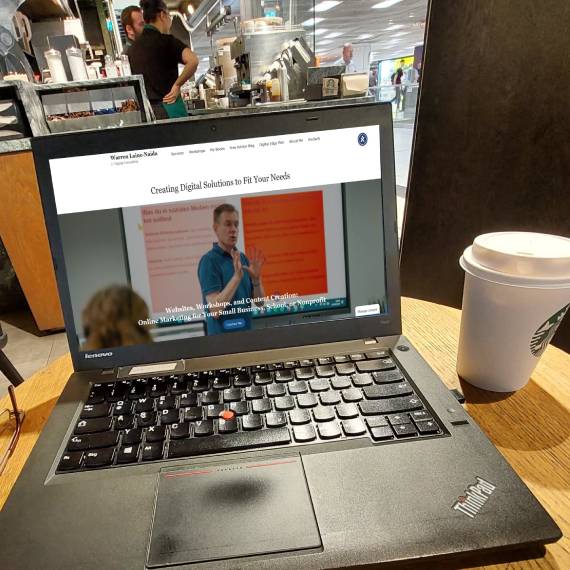
Here’s something you already know: coffee bars like Starbucks, Dunkin, Tim Hortons and others don’t really sell coffee. The coffee and muffin is just the hook. Coffee bars are really selling an experience, a status symbol, a third place between home and work.
You’re feeling good about paying premium prices for what amounts to roasted bean water and steamed milk in a disposable cup. Why? Your favourite barrista has mastered the art of making you feel like you’re getting more than you paid for.
No worries. Every trick, pricing strategy, and experience design principle Big Coffee uses to build billion dollar brands can be adapted by you, right now, with zero budget, a social media account, and a WordPress site.
Why do you need to step up your game? Competition. You’re probably competing on price, which means you’ve already lost.
If you’re listing your services like a grocery store, you’re invisible. But if you can make people feel like working with you is the smart, comfortable, status-enhancing choice? That’s when everything changes.
Read enough? Jump to the actionable stuff:
How Your Coffee Bar Uses Behavioral Economics to Drive Purchase Decisions – and You Can Too
Behavioral economics studies how psychology affects economic choices. Big Coffee boost sales with pricing tricks, cozy store designs, and menu nudges. This raises spending and loyalty. How do they do it?
Key Tactics with Psychological Foundations:
- Charm Pricing: Prices ending in 95 or 99 are processed by the brain’s left digit bias, making $4.95 feel significantly cheaper than $5.00 despite only a 5-cent difference.
- Anchoring Effect: Placing premium options (Venti, Trenta) on menu boards makes mid-tier options (Grande) appear more reasonable and increases selection of higher-margin products.
- Third Place Theory: Creating comfortable environments between home and work increases dwell time, which correlates with increased purchase frequency and basket size.
- Decoy Effect: The Tall size often serves as a decoy, priced close enough to Grande that customers perceive upgrading as high value, driving 80% of customers to mid- or large-size purchases.
- Default Bias: Baristas suggest Grande as the standard size, leveraging people’s tendency to accept defaults rather than make active choices.
- Sunk Cost Fallacy: Extensive customization options create psychological investment; customers who customize drinks are more likely to return and less price-sensitive.
- Status Signaling: Rewards programs and branded merchandise allow customers to signal taste, status, and group belonging, increasing emotional attachment to the brand.
How you can apply these tactics: These same principles can be applied to service packaging, pricing architecture, client onboarding experiences, and retention strategies without requiring physical products or retail infrastructure.
This isn’t theory. These are the exact tactics Starbucks uses to turn casual customers into regulars, and one-time purchases into lifetime relationships.
Every single one of them works just as well for freelance marketers selling SEO audits, WordPress builds, and social media retainers as it does for a corporation selling lattes.
Let’s break down the playbook.
The Coffee Bar Playbook for Freelance Marketers
Third Place Trap → Partner Space
Create an environment where prospects want to stay with you, just like your coffee bar keeps you in-store longer to increase spend.
Position yourself as “not just an agency, not just a freelancer, but your ongoing digital partner”. Mirror that in your hero copy and social bios. People want a partner, not a service provider.
Offer structured 30–45 minute strategy sessions or audits with clear outcomes and follow-up resources. The longer they engage, the more value they see and the more services they discover they need.
Why this works: Your coffee bar designed their stores to be comfortable enough that you’ll stay for another drink. You’re designing a relationship comfortable enough that clients stay for another project. The psychology is identical – create an environment where leaving feels like a loss.
Position yourself as a strategic partner, not just a vendor. … strategic partners don’t get fired over budget cuts; build-it-and-ship-it vendors do. Rocket.net
Charm Pricing & Money Illusion
Use price framing that feels smaller and less painful while staying premium, similar to your coffee bar’s pricing strategy.
List services as 495, 790, 1495 instead of 500, 800, 1500. Visually de‑emphasize the currency symbol to reduce perceived pain of paying.
Highlight prices with clear, outcome-focused bullets so they are read as investments, not costs.
Why this works: Your brain processes 495 as “four hundred something” while 500 registers as “five hundred.” It’s irrational, but it’s real. Starbucks knows this. Now you do too.
Menu Board Tricks & Premium Anchor
Lay out your services like a café menu with strategic placement and anchoring.
Put your highest-margin, most strategic offer (e.g., “Growth Retainer: SEO + Content + Social”) at the visual center of your pricing section with a badge such as “Most chosen by growing businesses.”
Add a visibly more expensive “Executive” or “Fractional CMO” package so your main mid-tier package suddenly feels “reasonable,” anchoring perceived value.
Why this works: When your coffee bar puts the Venti price next to the Grande, the Grande suddenly looks like the smart middle option. You’re doing the same thing – making your most profitable package look like the obvious choice by comparison.
Decoy Effect & Smart Middle Package
Create a three-tier structure where the smallest option is a decoy and the mid option becomes the natural choice.
For WordPress builds, offer “Starter,” “Growth,” and “Scale” where “Starter” is clearly underpowered; price “Growth” only moderately higher so it feels like the smart move.
Repeat the pattern for SEO and social media retainers, and in sales calls explicitly contrast the limitations of the smallest offer with the comfort of the middle one.
Why this works: Nobody orders a Tall at your coffee bar once they see it’s only 40 cents less than a Grande. Your “Starter” package exists to make “Growth” look irresistible.
The Venti Upsell → Normalized Upgrade
Normalize “bigger” and “ongoing” so upgrades feel standard, not pushy.
On calls, always ask, “Would you like to add ongoing optimization and reporting to keep these results compounding?” right after agreeing the core scope.
On landing pages and proposal PDFs, visually default to the option that includes monthly support or reporting, with the one‑off version as a smaller, secondary choice.
Why this works: The barista doesn’t ask “Do you want a Grande?” They ask “Is Grande okay?” The upgrade becomes the default, not the exception. Use the same language pattern in your proposals.
Viral Cups → Seasonal, Shareable Offers
Use limited-time, visually branded offers like your coffee bar’s holiday cups to trigger shares and conversation.
Run seasonal campaigns such as “New Year Conversion Cleanup,” “Back‑to‑Business SEO Tune‑Up,” or “Q1 Retargeting Sprint” with strong, consistent visuals across your site and social.
Encourage clients to share before/after results or dashboards on LinkedIn and Instagram (with their permission), and prepare easy-to-use visuals they can post with one click.
Why this works: Every Pumpkin Spice Latte becomes free marketing when people post about it. Every client case study becomes free marketing when you make it share-worthy. Design for virality.
Scent Marketing → Experience Cues
Replace physical scent with consistent digital cues that instantly “feel like you.”
Use a distinct visual language, tone of voice, and microcopy across your website, emails, proposals, and reports so people recognize your “signature” immediately.
Bake in small positive surprises in onboarding, like an unexpected quick fix, a mini audit video, or a custom checklist, to associate your brand with pleasant anticipation.
Why this works: Your coffee bar – just like McDonalds – smells the same in every city on earth. Your brand should feel the same everywhere – from your first email to your final invoice. Consistency builds trust. Surprises build delight.
Name Trick → Personalized Assets
Use people’s names and brands everywhere to trigger attention and emotional connection. Refer to projects as “our website, our posts, our analytics”.
Title deliverables and walkthroughs with the client’s name and CI and show that title clearly in thumbnails and screenshots.
In emails and proposals, reflect back their exact language about goals and pains; this deepens the feeling that the solution is uniquely tailored to them.
Why this works: Hearing your name on your coffee cup creates a micro-moment of recognition and ownership. Seeing your business name on a deliverable creates the same emotional spike. It’s personal. It’s theirs. It matters.
Customization & Sunk Cost
Borrow your coffee bar’s intense drink customization. Use it as a configurator for your services.
Add a “Build your own growth stack” form where people choose WordPress, SEO, CRO, email, and social components; show a dynamic preview of “Your custom plan” so they feel ownership before you even talk.
During calls, co-create a shared roadmap document and send it immediately afterward; because they helped build it, abandoning the plan feels like wasting their own effort.
Why this works: The more customization someone requests, the more invested they become. Your coffee bar knows this. That’s why they let you order a half-caf, soy, extra-hot, no-foam latte. They’re not just taking your order – they’re getting you invested in the outcome.
Scarcity, Status, and Community
Mirror your coffee bar’s seasonal scarcity and rewards tiers to make working with you feel like joining a club, not buying a commodity.
Offer limited-cohort programs with a visible counter or deadline on landing pages to nudge quicker decisions.
Create a lightweight “VIP client” layer: private community, office hours, early access to new templates, and public shout-outs on LinkedIn so clients gain status and belonging by staying with you.
Why this works: Your coffee bar doesn’t just sell Gold status – they sell the feeling of being an insider. You’re not just offering services; you’re offering access. And access always beats availability.
The Uncomfortable Truth About Pricing Psychology
Look, I get it: pricing psychology feels manipulative because it is. But manipulation and persuasion are separated by intent, not technique.
Big Coffee uses these tactics to make you pay more for coffee. You can use them to make clients feel confident paying premium rates for work that genuinely solves their problems.
The difference is that you’re not inflating the value of your work – you’re removing the irrational friction that prevents people from seeing the value that’s already there.
If you’re better than the competition but charging the same rates, you’re leaving money on the table. If you’re delivering great results but clients don’t renew, you haven’t built the right experience. If you’re constantly justifying your prices, you haven’t framed them correctly.
Starbucks figured this out decades ago. You can figure it out today.
Your Four-Week Implementation Plan
Stop reading, grab a coffee, and start doing!
Here’s how to implement these tactics in the next month.
Week 1: Pricing and Positioning Audit
- Rewrite all service prices using charm pricing (495, 790, 1495 instead of 500, 800, 1500)
- Create a three-tier structure for each service with a clear “most chosen” middle option
- Add one premium anchor package that’s 2-3x your current highest offering
- Update your hero copy to include “partner” language instead of “freelancer” or “agency”
Week 2: Experience Redesign
- Create a signature visual element that appears in all deliverables (color scheme, header style, icon set)
- Write three “surprise and delight” moments into your onboarding sequence
- Design client deliverable templates with their name/brand prominently featured
- Set up a simple post-project email sequence with one unexpected bonus resource
Week 3: Upsell and Seasonal Campaign
- Create a “Build Your Growth Stack” configurator form or landing page
- Write your first seasonal campaign (pick one: Holiday Audit, Q1 Planning Sprint, or Spring Cleanup)
- Design social-ready case study templates clients can share with one click
- Add default upgrade language to all proposals and sales calls
Week 4: Community and Status
- Create a lightweight VIP tier (even if it’s just a private Slack channel and monthly office hours)
- Write and promote one limited-cohort offer with visible scarcity (10 spots, expires in 14 days)
- Set up brand mention monitoring and start publicly celebrating client wins
- Document what worked and plan next month’s implementation
The only rule: Implement one full tactic before moving to the next. A well-executed pricing change beats five half-finished “improvements.”
What Success Actually Looks Like
You’ll know this is working when:
- Clients stop asking “Why does this cost so much?” and start asking “What’s included in the Growth package?”
- Your average project value increases by 20-40% without changing your hourly rate
- Clients proactively ask about ongoing retainers instead of you having to pitch them
- People refer to you by name, not by “my SEO person” or “the guy who did our website”
- You stop competing with $500 Fiverr gigs because you’re not in the same category anymore
That’s not theory. That’s what happens when you stop selling services and start selling experiences, status, and transformation – just like Starbucks.
Wrapping Up: Latte for Hank!
Big Coffee didn’t become a 500 billion dollar industry by selling better coffee. They made 500 billion by understanding that people don’t buy products – they buy feelings, status, belonging, and the confidence that they made the smart choice.
You don’t need a retail empire to apply these same principles. You need a pricing page, a proposal template, and the willingness to stop undervaluing your work.
Every tactic here works. The question isn’t whether they’ll work for you – it’s whether you’ll actually implement them.
Your competition is already underpricing, under-delivering, and under-thinking their positioning. If you do even three of these tactics well, you’re not competing with them anymore. You’re competing with Big Coffee. And honestly? You’ve got better margins.
Business Advice – Plan, Execute, Measure, Adjust, Succeed!
More free advice for your SEO, Website, Social Media, AI Content …
I’m passionate about training small business owners, schools, and nonprofits, to be active participants in their online marketing efforts. I’ve seen too many business owners victimised by snake oil salespeople, promising much and doing little. That has to change. All of my advice here is free!
- How Your Small Business Can Use Social Media, SEO, and WordPress to Drive Growth
- Local SEO and Geo-Targeting: How to Be Found Where It Matters Most
- How Your Small Business Can Use AI for Big SEO Wins
- Yes, Your Small Business or Nonprofit Can Get Results from Google Ads on a Tiny Budget