
Last Updated on June 18, 2026
Why My Engagement Graph Looks Like a Rollercoaster
TL;DR – Key Takeaways
- Borders show up in your analytics. Same person, same platform, wildly different numbers depending on which country I was posting from.
- Americans amplify; Germans absorb. The US rewards expressiveness and fast, warm replies. Germany rewards depth, privacy, and a slower kind of trust.
- Neither feed is “better.” One gives you reach. The other gives you relationships. You want both.
- Authenticity travels. The posts that worked in both places were the ones that weren’t trying to perform for an algorithm at all.
The Trip That Became an Accidental Case Study
I didn’t go to California to run a social media experiment. I went for two weeks of sunshine, questionable amounts of fast food, meeting with old friends, and the particular joy of driving somewhere just because you can. In the end that drive covered almost 2000 miles!
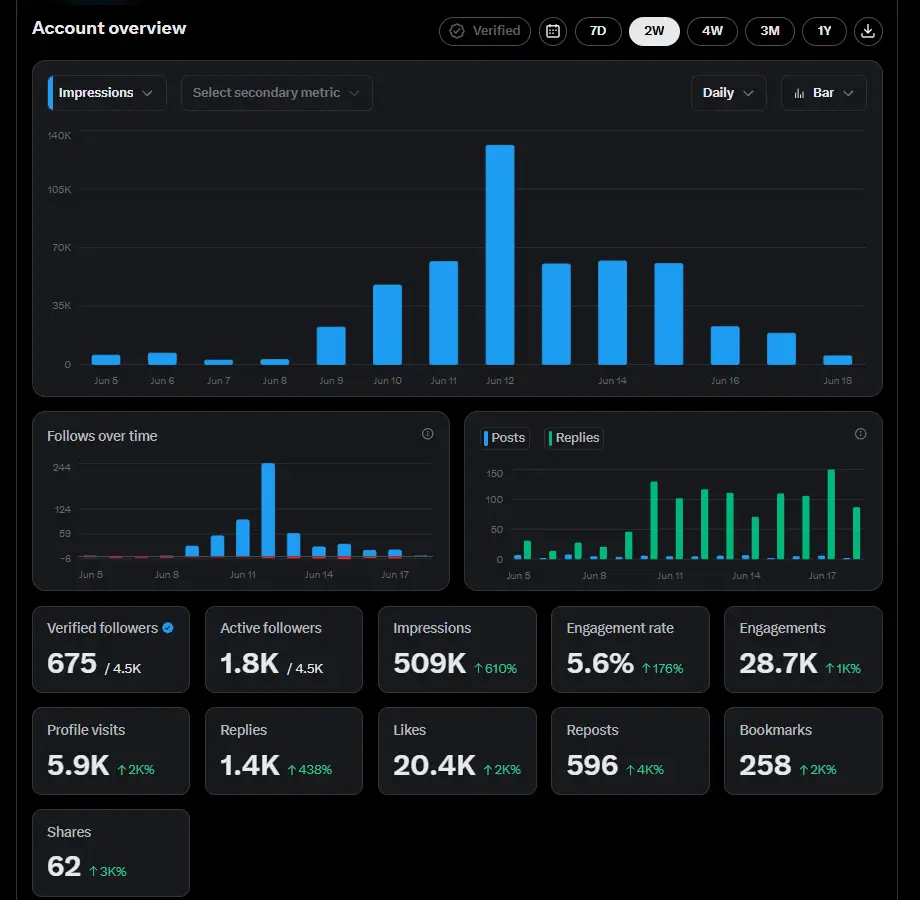
But I’ve been doing SEO and digital coaching from Germany for over 25 years, and old habits don’t switch off just because you’re on vacation. Somewhere around day five, I noticed my X notifications behaving like they’d had too much coffee.
Posts that would normally get a polite trickle of likes back home were suddenly pulling in thousands of likes and tens of thousands of views. “You are the friendliest, greatest country!” Ranch dressing jokes. Mild bewilderment at being handed a water bottle the size of a small dog.
None of this was calculated content strategy. It was just me, talking out loud about what I was noticing. And Twitter X just lit up.
That contrast – between my usual, steadier German activity and this sudden American surge – turned into the most interesting unplanned research project I’ve run in a while.
Activity, Tasks, and Why the Same Post Performs Differently in Two Countries
“Social media isn’t just about posting content. It’s about building relationships at scale.” warrenlainenaida.net/why-small-biz-still-needs-social-media
A feature is “X is a social network where you post short updates.” An activity is “I want to feel connected to people while I’m far from home, and I want them to feel something back.” Same tool, completely different activity depending on who’s holding it and where.
In the US, that activity looked like this:
- Post something light, honest, slightly self-deprecating about being a foreigner abroad
- Watch replies arrive within minutes, warm and enthusiastic
- Get amplified by people who don’t know me at all
- Feel, briefly, like part of a very large, very loud dinner table
In Germany, the same activity runs through a different sequence:
- Post something useful or thoughtful – WordPress, SEO, daily life
- Get fewer, slower responses
- Build something closer to a real conversation than a reaction
- Feel like I’ve made a small, durable connection rather than a brief splash
Neither sequence is wrong. They’re just optimized for different constraints.
The Missing Piece: What Each Audience Is Actually Optimizing For
“The most important thing you can do on social media is show up consistently.” warrenlainenaida.net/the-three-most-important-things-about-your-social-media
- Openness – American replies came fast and warm, even from total strangers. The “we survived without a personal water bottle” energy was met with genuine enthusiasm, not suspicion.
- Privacy – German engagement stayed lower-volume and more guarded, which tracks with everything we know about German attitudes toward sharing and data generally.
- Pace – US engagement was immediate. German engagement was considered. Neither is slow because people aren’t interested; it’s a different relationship with public expression.
- Trust – In the US, my credibility came from being clearly, harmlessly foreign and enjoying myself. In Germany, it comes from years of being useful – SEO tips, WordPress help, consistency over time.
- Volume vs. depth – American posts amplified fast and faded fast. German posts arrived slowly and stuck around longer in actual conversation.
Each of these constraints is a content opportunity, not a flaw in either market.
Two Feeds, Two Strategies
Energy
(US) = Light, observational, emotionally warm posts about everyday culture-shock moments. This is the content equivalent of small talk at a barbecue, and X rewarded it the way a barbecue would: instantly, loudly, and with no permanent record required.
Depth
(Germany) = Professional, practical posts – SEO insights, WordPress tips, the occasional honest reflection. Fewer likes, but the replies that do show up tend to come from people who actually remember the post a week later.
Reach
(US) = Strangers amplifying a post because it captured something they recognized about their own country. I didn’t earn that audience. I borrowed it, briefly, by being a visibly delighted guest.
Relationship
(Germany) = A smaller, steadier audience that has watched me show up consistently for years. That’s not reach. That’s retention.
From Two Cultures to One Strategy
“Your website, SEO, and social media should no longer be treated as separate marketing channels.” warrenlainenaida.net/aligning-seo-social-media-your-website-for-the-year-ahead
Here’s the part that matters for anyone managing a presence across borders: you don’t need to pick one mode and force it everywhere. You need to recognize which mode you’re in and stop expecting home-style depth to behave like American-style amplification, or vice versa.
| Market | What Gets Rewarded | What It Builds |
|---|---|---|
| USA | Warmth, humor, expressiveness, fast amplification | Reach, momentum, broad visibility |
| Germany | Usefulness, restraint, consistency, depth | Trust, retention, professional credibility |
Trying to make your home audience (in my case German) react like your American one – or vice versa – isn’t a content problem. It’s a category error.
The Resilience Play
“People connect with people before they connect with brands.” warrenlainenaida.net/how-you-can-better-use-social-media/
Here’s the bigger picture. If your entire social strategy is “post the same thing everywhere and hope for the same result,” you’re building on sand. What survives border-crossing is content built around what an audience actually values – not a one-size-fits-all posting calendar.
For me, that meant the trip didn’t break my usual German rhythm. It added a second register: the warm, fast, expressive one that the US audience clearly wanted, sitting alongside the steady, useful one that Germany has always rewarded. Together, they’re a more complete picture than either one alone.
A Practical Starting Point (For Your Next Trip, Not Your Next Funnel)
You don’t need to overhaul your whole strategy to use this. Start here:
- Notice where you’re posting from, literally. If your engagement patterns shift drastically by region, that’s data, not noise. Pay attention to it.
- Don’t force one country’s tone onto another’s feed. What reads as charming spontaneity in the US can read as oversharing in Germany. What reads as professional restraint in Germany can read as cold in the US.
- Let genuine stories do the work. The posts that performed everywhere – not just in one market – were the ones that weren’t trying to perform at all. They were just true.
Helpful Info from the Source
Location, Location, Location … and Timezone
Your physical location and internet connection override your static profile settings because X prioritizes real-time geographic data to serve local content clusters.
Real-Time Tracking: X tracks your temporary US IP address via local Wi-Fi or cellular networks, immediately shifting you into the American geographic algorithm pool.
Hyper-Local Feed Boost: The platform builds “For You” feeds fresh for each user by mapping them to local communities. Being physically in the US injects your posts straight into these regional pools.
Market Size Disparity: Don’t forgef, the active user pool on X is significantly larger and more engaged in the United States than in Germany.
The “Rubber Band” Effect: Returning to Germany forces an automatic network swap back to a German IP, prompting the system to pull you out of the massive US feed loops and flatten your reach metrics back to normal.
For more detailed information regarding how the platform processes and customizes your user experience based on geographic locations, refer to the X Help Center Page on Personalization and Data Processing https://help.x.com/en/rules-and-policies/data-processing-legal-bases
The Big Insight
“Social media is not about broadcasting. It is about conversations.” Say that again and again … @bridgetwillard sold me on this mantra this back in 2020 :o)
I didn’t plan any of this as a strategy. I just kept being myself in two different countries and watched two different audiences respond to that same self in two genuinely different ways. The US reminded me how fast warmth travels when you let it be visible. Germany reminded me that depth doesn’t need an audience of thousands to be worth showing up for.
Good cross-border social media isn’t about picking a personality. It’s about understanding which version of honesty each room is ready to hear.
Social media isn’t about a specific platform, and it isn’t just about you – it is about the people around you. Those people are your friends, your members, and your customers – existing and future!
I help small businesses, schools, and nonprofits master digital skills – SEO, WordPress, and the occasional cross-cultural social media experiment conducted entirely by accident!