Last Updated on September 20, 2026
Google recently dropped its official documentation on optimizing for generative AI features. Did you miss it?
https://developers.google.com/search/docs/fundamentals/ai-optimization-guide
For the last year or two, a lot of GEO people have been peddling sketchy “hacks” to trick the algorithms. At the same time, serious SEOers and teachers, like myself, have been trying to support clients and students charting unknown waters.
Google’s release was intended to clear the air, and, I was very curious how much that I have written about AI & SEO lines up with Google’s official stance. So I did a side-by-side analysis – Google directly against my own AI SEO/GEO framework. The Result: Google and I are in absolute alignment on the core philosophy, but we purposefully diverge on the practical mechanics of survival.
My consulting philosophy has always been unapologetically human-first, sustainable, write your content and do not sweat the search algorithms. I believe that exact-match keyword strings do not create demand – real human conversations do. For that reason I prefer Off-Page SEO. In fact, I always joking say that I will fight anyone who disagrees with me!
I think AI systems like Google AI Overviews, ChatGPT, and Perplexity are simply advanced synthesis machines trying to capture, evaluate, and map our conversations. Why? They want to know the best source of information for every question.
Google AI SEO Guidelines vs Warren’s AI SEO Guidelines
Here is my breakdown of where Google’s official guidelines hit the mark, and where they leave glaring gaps that could leave your business invisible.
The Structural Alignment: What We Agree On
Google confirms what I have told my students and clients for years: SEO is not dead. Generative AI search features rely fundamentally on Retrieval-Augmented Generation (RAG). The AI doesn’t magically invent answers out of thin air; it pulls from a trusted core search index. If you lack basic technical SEO health (crawlability, indexability, speed), you simply do not exist to the AI.
Furthermore, Google explicitly validates my war on “commodity content”. They write that recycling common knowledge offers zero value. I frame this as the dividing line between commodity information (which AI generates instantly) and unforgettable content.
To be cited – by people or by an AI engine- you must offer unique, expert-led, first-hand experiences, and real storytelling that an LLM cannot replicate.
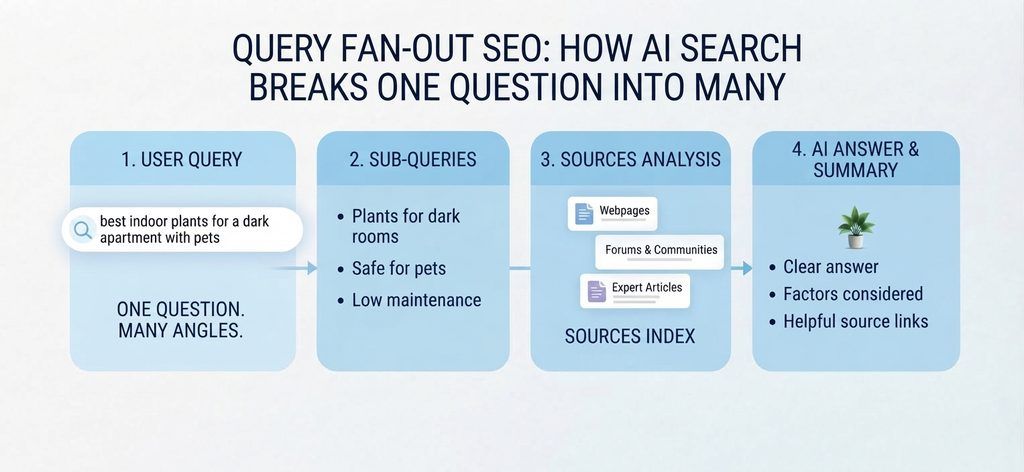
The “Query Fan-out” Validation: Search Queries automatically generate concurrent, related queries behind the scenes. This explicitly proves that legacy keyword stuffing is obsolete. Google is actively building semantic topical networks. If you don’t own the broader concept ecosystem around your topic, you won’t be invited to the AI synthesis.
The Technical Deep Dive: Code, Crawling, and Complexity
When analyzing the backend architecture required to power generative search, Google and I are viewing the exact same machine through different lenses. Google writes to protect its infrastructure efficiency; I write to protect your visibility across a fractured internet.
Baseline Eligibility vs. Universal Invitations
- Google’s Stance: You must meet basic Search technical requirements to be crawled and indexed. If you are not eligible for a traditional search snippet, you are ineligible for generative AI features. They remind webmasters that indexation is never a guarantee.
- My Stance: Baseline technical SEO is merely your ticket to enter the game. Think of it this way: Google SEO gets you into the index, but GEO determines if the AI actually synthesizes your data into an answer.
Semantic HTML: Corporate Shortcuts vs. Machine Safety Nets
- Google’s Stance: Don’t obsess over valid HTML or perfect code. Google’s systems can easily read sloppy pages. They relegate semantic HTML to a “good idea” primarily intended to help screen readers navigate.
- My Stance: This is a critical point of divergence. Google has a multi-billion dollar parsing pipeline – smaller LLMs, scraping tools, and custom browser agents do not. Enforcing a flawless, strict hierarchy of heading tags (H1-H6) is a mandatory baseline for multi-engine visibility. Clean, semantic HTML ensures your data is readable for all AI models, not just Google’s.
JavaScript Frameworks and Server-Side Realities
- Google’s Stance: Google can process content hidden behind JavaScript, but they openly admit it makes rendering and indexing significantly more complex. They advise strict adherence to traditional JavaScript SEO basics.
- My Stance: Keep it lightweight and favor fast, server-side rendering. AI scrapers and browser agents prioritize raw text over complex processing. If your core marketing messages require heavy client-side JavaScript execution to render, you risk being skipped over by resource-constrained AI crawlers.
Duplicate Content vs. Entity Consolidation
- Google’s Stance: Reduce duplicate content across your site to prevent search engines from wasting valuable crawling resources on URLs you do not care about.
- My Stance: Google views duplicate content as a “crawl budget” drain. I view it as an authority drain. When your information is scattered across thin, repetitive pages, you confuse the LLMs trying to map your entity. Aggressively consolidate duplicate content into organized, comprehensive content hubs to make your expert stance unmistakable. That said – no content is worse than duplicate content!
Page Experience as a Conversion Bridge
- Google’s Stance: Provide a fast, device-agnostic experience, lower latency, and clearly isolate main content from secondary page clutter.
- My Stance: We agree on the execution, but our “why” is entirely different. Google wants to keep web users satisfied. I want to save your conversions. Because generative search answers user queries directly on the search page, click-throughs to your site are rare but carry incredibly high intent. If a user lands on a slow, clunky page, they will bounce instantly back to the AI interface, and you lose them forever.
The Side-by-Side Reality Check
| Technical Element | Google’s Crawler-First Stance | My Human-and-Machine Stance | Strategic Status |
| Indexation Base | Technical eligibility is mandatory to feed the RAG pipeline. | Baseline technical SEO is required just to enter the game. | 🟢 Aligned |
| Content Value | Create unique, expert takes. Avoid recycling common knowledge. | Eliminate “AI slop.” Prioritize unforgettable human experience. | 🟢 Aligned |
| Semantic HTML | “Don’t worry about perfect code,” our systems can figure it out. | Hierarchy and semantic HTML is till best practise, even if Google doesn’t require it. | 🔴 Divergent |
| Content Chunking | Mythbusted. No need to break content down for our index. | Chunked content is easier to find, scan, and use. Stick with it! | 🔴 Divergent |
| JavaScript | We can process it, but it adds a layer of rendering complexity. | Keep it lightweight. Bots favor raw text over execution delays. | 🟡 Nuanced |
| Duplicate Content | A waste of our crawling budget and resources. | Dilutes your brand’s topical footprint and entity clarity. | 🟢 Aligned |
| Ecosystem Scope | Exclusively focused on Google Search and Google Overviews. | Multi-engine visibility (ChatGPT, Claude, Perplexity, etc.). SEO is more than Google. | 🔴 Divergent |
The Road Forward: Proactive Resilience
As we look toward the future of search, the biggest mistake you can make is falling into the trap of reactive optimization. Rewriting your entire website every time an algorithm updates is an exhausting, losing game. Instead, we must focus on proactive resilience.
Own the “Information Origin”
AI models operate by scraping and synthesizing existing data. If your platform only summarizes what others are saying, you are structurally irrelevant. You must become the origin of data. Conduct original industry surveys, publish raw case studies, or document proprietary frameworks. When you are the primary source of a unique truth, AI engines are practically forced to reference you.
Treat LLM Diagnostics as Your New Focus Groups
We are moving completely away from traditional keyword volume tracking and transitioning into sentiment and context tracking. Make it a monthly routine to audit ChatGPT, Gemini, Perplexity, and Claude. Prompt them with industry questions like “Who are the trusted authorities on this topic?” and see who they pick. Analyze why they choose competitors over you – whether it’s due to digital PR gaps, schema issues, or formatting – and adapt.
Protect Intellectual Property vs. Feeding the Machine
There is a real strategic choice ahead: Do you let AI engines crawl your site for free to get an overview citation, or block them? For basic educational content, leave the doors open to earn those links. But for your deepest, most high-value, unforgettable insights – consider moving them behind paywalls, newsletters, or premium spaces. Do not give away your core IP to train engines that might bypass your traffic entirely.
Build a Brand That People Search for By Name
The absolute ultimate safety net is brand equity. If a user asks an LLM for the “best digital strategy,” they get a synthesized composite response. But if they type, “How does Warren Laine-Naida approach digital strategy?” they get a specific blueprint. Shift focus toward building genuine community, podcast appearances, and real-world authority. When people search for your brand or frameworks explicitly by name, algorithm updates lose their power to disrupt your business.
Further Reading: What the Data Says About GEO and Traffic Loss
SEO expert Lily Ray recently analyzed 15 companies built around AI-generated content. The findings are sobering: over half lost 30% or more of their organic traffic, with nearly 40% losing more than half their peak traffic.
Her conclusion mirrors mine: generic content that simply answers Who, What, When, and Why is increasingly handled directly by LLMs. The sites hit hardest are those whose content an AI can replicate instantly.
Her fix is the same one argued here – stop producing for volume, start producing from genuine expertise that no language model can fake.
Another great article, this time from Cyrus Shephard on Substack: AI search engines generate multiple hidden fan-out queries behind every prompt to gather definitions, comparisons, examples, and supporting information before producing a final answer. As a result, success in AI search depends on appearing across these related research paths – not just ranking for a single keyword.
Cyrus recommends a simple five-step framework:
- Start with a keyword you already rank for.
- Find common fan-out queries.
- Prioritise the most important fan-out topics.
- Optimise existing pages – or create new ones – to cover those topics.
- Measure AI visibility and citations.
The Final Word
Don’t build your digital house entirely on rented land.
Google’s guidelines will change again next year, OpenAI will pivot, and alternative search models will emerge. To build a future-proof brand, adopt Google’s foundational advice on expert, non-commodity content, but apply my technical rigorousness regarding semantic structures, modular chunking, and multi-engine optimization.
If you anchor your architecture in true human expertise and absolute transparency, you won’t have to scramble when the algorithms shift. You will naturally be exactly what both humans and machines are looking for.