Last Updated on September 25, 2026
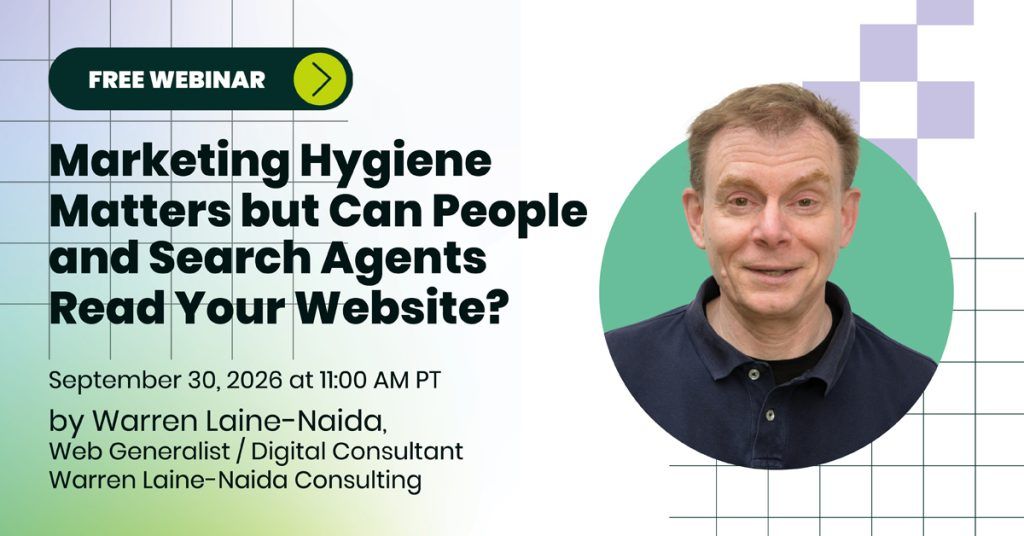
A GreenGeeks Webinar with Warren Laine-Naida
Sept 30, 2026
Another Free GreenGeeks webinar!
How accessibility drives AI-readability, SEO, and lower-carbon websites.
With actionable, quick agent-friendliness audit steps!
AI agents (and they are just one of five groups accessing your website) don’t browse your website like a human does; they parse it.
A cluttered, JavaScript-heavy site that’s hard on screen readers is often just as hard on the bots now reading, ranking, and recommending it.
This session breaks down why accessibility, SEO, and AI-readability have quietly become the same job – and what that means for your site’s real carbon footprint. #SEO #AEO #Accessibility
What You’ll Learn in this Webinar:
- Why Accessible Sites Are the Sites AI Agents Actually Understand
- The Hidden Carbon Cost of Bloated, JavaScript-Heavy Pages
- Quick Audit Steps to Improve Rankings, Access, and AI Visibility Together
Other GreenGeek Webinars with Warren
See all of the GreenGeeks Webinars right here: https://www.greengeeks.com/webinars/
Are We Making Accessibility Too Complicated?
Yes.
WordPress said they are bringing out an Agent-friendly theme called “Ipsum”. https://make.wordpress.org/core/2026/09/16/introducing-ipsum-the-new-default-theme/ But, do we need another theme?
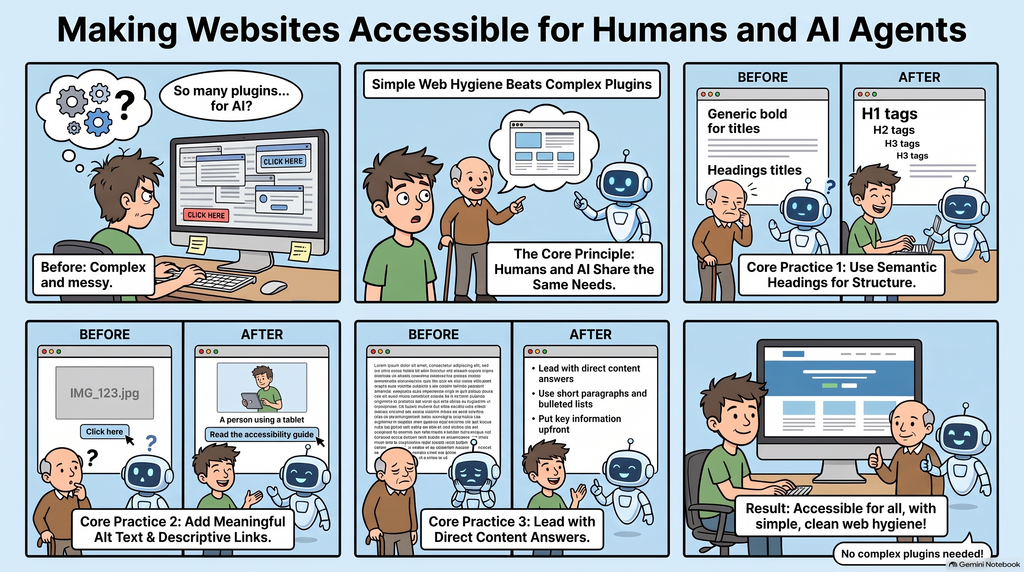
Having an accessible website is not that complicated. The principle is: Clear structure > easier for people to navigate > easier for machines and agents to understand.
Do I Need a Special Theme?
No.
What you need is a simple theme. Elementor is not going to help you here. Generate Press is a good start. Maybe Ipsum too.
There are four things you can do now, that will positively impact your website’s usefullness for people and bots/agents.
The Simple Test
Look at your website and ask: Can a person understand it without struggling?
If yes, you’re already doing a lot of the work required to make it understandable to an agent.
No magic, just good web hygiene.
4 Things Your Website Needs to Be Agent-Ready and Accessible
You don’t need an AI plugin to make your website more useful to AI agents. Juststart with the basics.
The things that make a website easier for people to understand often make it easier for machines to understand too.
Clear structure, meaningful language and accessible HTML are good for SEO, accessibility and AI visibility.
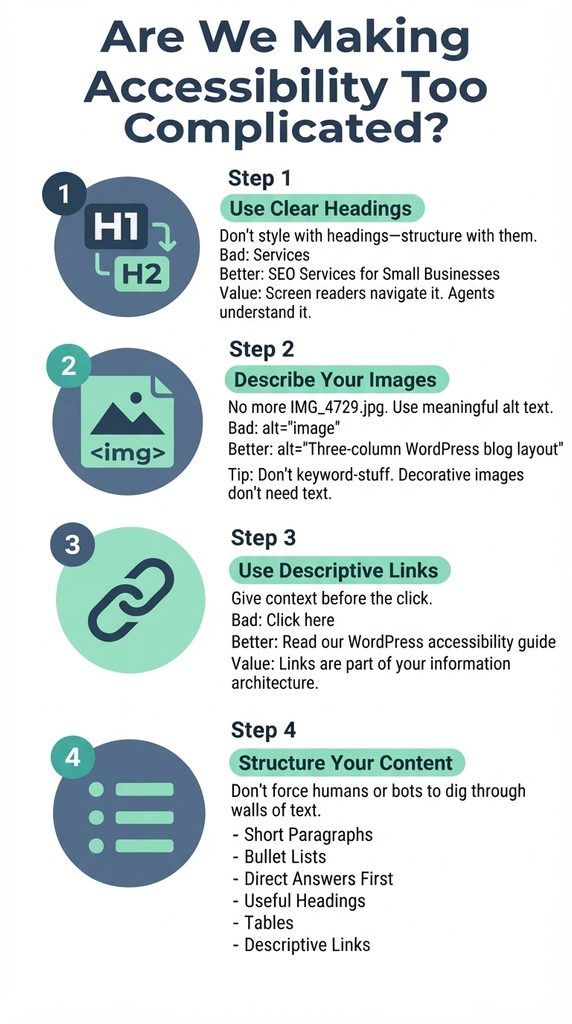
1. Use Clear Headings
Don’t use headings because they look good. Use them to structure the page.
One H1. Then H2s for the main sections. H3s for sections within those sections.
Bad:Services
Better:SEO Services for Small Businesses
A person can scan it. A screen reader can navigate it. An agent can understand what the section is about.
That’s the point of semantic HTML: give the content meaning, not just appearance.
2. Describe Your Images
Don’t leave important images as IMG_4729.jpg.
Give meaningful images useful alt text.
Bad:alt="image"
Better:alt="Three-column WordPress blog layout"
Don’t stuff keywords into alt text. Describe what matters.
And if an image is purely decorative, it doesn’t need a description.
Simple. Accessible. Useful to machines too.
3. Make Navigation and Links Descriptive
“Click here” tells nobody much.
Try: Click here > Read our WordPress accessibility guide
The second link tells you what you’re going to find before you click it.
Make your navigation just as clear:
- Use descriptive menu labels
- Keep navigation consistent
- Give buttons clear names
- Use descriptive link text
- Make the path between related pages obvious
That’s useful for people using screen readers, people scanning a page and machines trying to understand relationships between pages.
Your links and navigation are part of your information architecture. Make them count.
4. Make Important Information Machine-Readable
Don’t make people – or machines – work out what important information means.
Use clear HTML and, where appropriate, structured data to identify things such as:
- products
- services
- prices
- dates
- locations
- organizations
- events
For example, don’t just write:
SEO consultation – €500
Use appropriate markup so that the page clearly identifies the service and its price.
This isn’t about adding an AI plugin or creating a special AI version of your website. It’s about making important information explicit and machine-readable.
People should be able to understand your content. Machines should be able to identify what that content represents.
Useful references and further reading
- AI agents and the accessibility tree: WebKing (2026) explains why agents read your accessibility tree, not your design, with concrete markup checks. webking
- How AI Agents See Your Site llmranks.io
- Accessibility as an SEO/AEO signal: Accessibility.works (2026) frames WCAG compliance as the foundation for GEO/AIO/LLMO. accessibility
- Carbon of JavaScript frameworks: Should I Use This Framework (2026) provides CO₂/page data by framework and optimization guidance. shouldiusethisframework
- Sustainable Web Design targets: SiteGrade and related 2026 guides outline 0.5g/page targets and practical reduction tactics. sitegrade
- Warren Laine‑Naida on accessible SEO and AI: Podcast episodes and talks emphasize “good HTML, clear headings, structured content” as the core of AI‑optimized SEO. stunningdigitalmarketing
- Let People and Bots Access Your Website: Whether machines can access, understand, find, and act on it now decides whether people show up at all. (2026) linkedin.com